Since 2019 every Spanish employer must keep a daily record of working time. The problem is rarely that none exists: it is that one exists and bears no resemblance to what happened, because it was filled in at the end of the month, or because you clock in on arrival and keep working two hours after clocking out.
That is what a working time report is for: take the employer's record, set it beside the sources that cannot be dressed up — the tachograph, GPS, delivery notes, emails — and show where they fail to match.
Cases I take
- Overtime, availability and night hours worked and not paid.
- Missing, incomplete or retrospectively completed records for the period they document.
- Records that do not match the tachograph, GPS, delivery notes or job sheets.
- Individual claims and collective disputes over working time and rest periods.
- Labour Inspectorate proceedings and penalties against the employer.
- Defending the employer where the worker's claim is not supported by the data.
What I need from you
- Working time records for the period, in whatever format the employer keeps them.
- Payslips, employment contract and the applicable collective agreement.
- App clock-ins, signature sheets or rosters.
- Tachograph downloads, GPS data and delivery notes, where the job involves driving or deliveries.
- Emails, messages and any time-stamped trace of the actual activity.
- The employer's working calendar and the holidays actually taken.
What the law says
- Art. 34.9 of the Workers' Statute: daily record of working time, introduced by Royal Decree-Law 8/2019.
- Art. 35 of the Statute: overtime, its calculation and its payment.
- Art. 59 of the Statute: one-year limitation period for wage claims.
- LISOS: infringements relating to working time and record keeping.
- CJEU judgment of 14 May 2019 (C-55/18) and Spanish Supreme Court case law on time recording.
What you get
- A reconstruction of your actual working time, day by day, with the source of every figure.
- All four calculations — daily, weekly, fortnightly and annual — and which one governs under your agreement.
- The gap between what was recorded, what was worked and what was paid.
- The hours quantified and priced at the agreement's hourly rate.
- Annexes with the raw data and the cross-check between sources.
- Ratification and defence of the report in the courtroom.
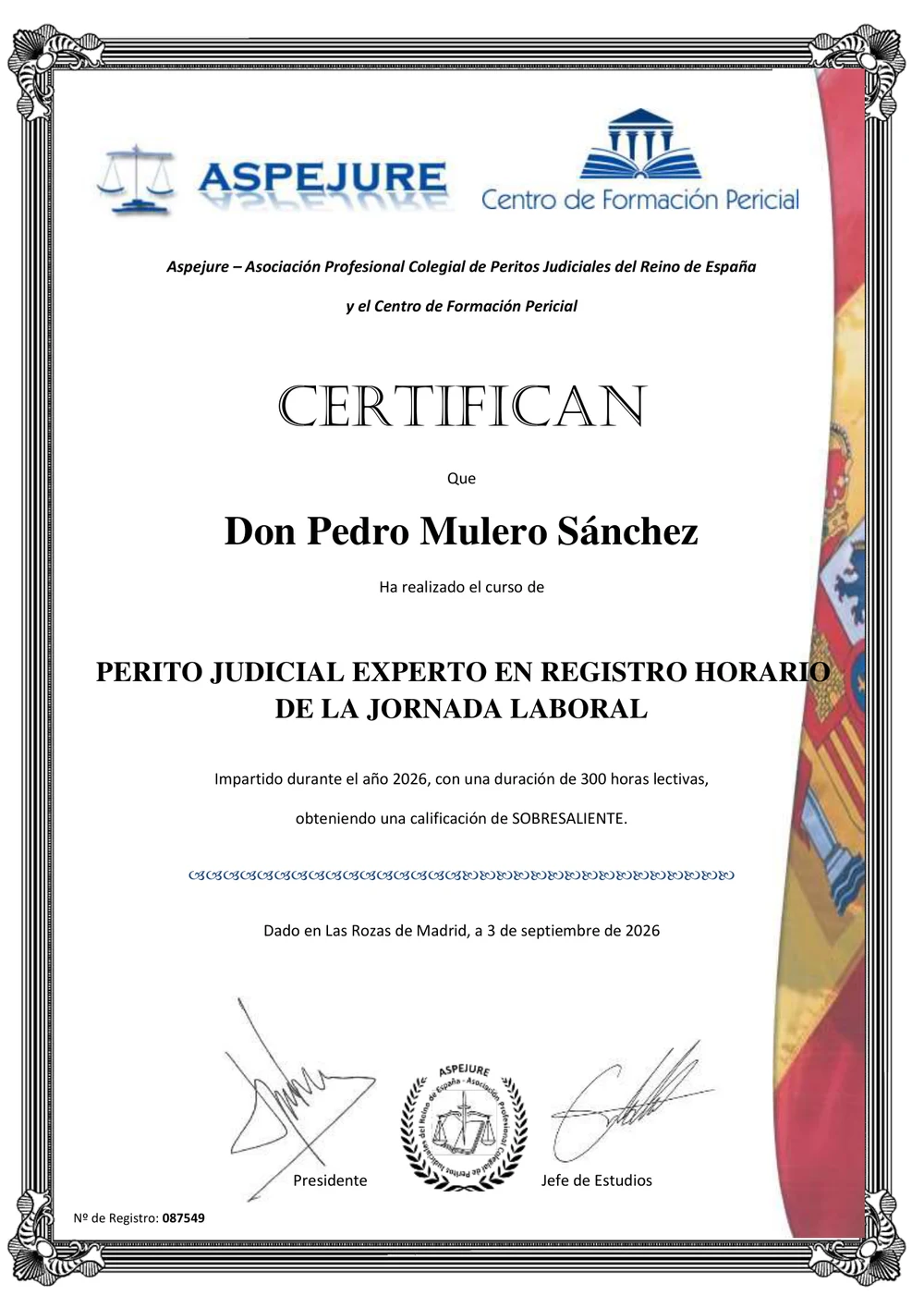 Working Time Records
Frequently asked questions
Must the employer give me my records?
Yes. The record must be kept for four years and made available to the worker, their representatives and the Inspectorate. If it is withheld, that in itself is a fact the report records and the court weighs.
Are my own notes any use?
They are evidence of a sort, and they gain real weight when they agree with independent sources: delivery notes, tachograph, location data, time-stamped emails. The report does not rest on your word alone; it tests it.
What if the employer keeps no record at all?
Then it has no evidence with which to contradict you, and that counts against it. It is also a punishable infringement. The report reconstructs the working time from the available sources and explains what could be established, and from what.
Free feasibility study and a fixed written quote. I reply within 24-48 working hours.