Since the reform of the Spanish motor injury scale, minor neck injuries are only compensated where the accident was capable of producing them. Insurers almost always deny it with a standard report; the answer has to be technical too.
Biomechanics puts numbers where there was argument: how much energy each vehicle absorbed and what change in velocity the occupants underwent. Diagnosing and assessing the injury is the doctor's job. My report supplies the physical side that the intensity criterion needs.
Cases I take
- Whiplash and low-speed rear-end collisions.
- The intensity criterion in art. 135: whether the impact energy is adequate for the mechanism described in the medical reports.
- Replies to the insurer's biomechanical report refusing compensation.
- Change in velocity (delta-V) and occupant acceleration from the mass and stiffness of the vehicles.
- Collisions with a lorry, coach or van, where the difference in mass changes everything.
- Occupant position and seat belt use as inputs to the calculation.
What I need from you
- Police report and accident statement, with the description of the impact.
- Photographs of the damage to both vehicles and an itemised repair estimate.
- Medical reports, which describe the mechanism and the injury: the diagnosis is the doctor's.
- Photographs of the interior: seats, head restraints and seat belts.
- Vehicle data: mass, type and, where available, the EDR record.
- The opposing side's biomechanical report, if there is one.
What the law says
- Art. 135 of the consolidated Motor Liability and Insurance Act: causation criteria for minor spinal trauma, including the intensity criterion.
- Act 35/2015: the Spanish compensation scale for road traffic injuries.
- Art. 7 of the same consolidated Act: the insurer's duty to make a reasoned offer.
- Scientific literature on acceleration thresholds and neck injury, cited with its source.
What you get
Report produced with the Perito Tacho Method (MPT®): ten phases common to every speciality, with the defensibility index and the stress test.
- Impact energy and the occupants' change in velocity (delta-V), calculated by more than one method and with its margin.
- Acceleration and direction of the occupants' movement in the impact.
- That intensity set against the mechanism described in the medical reports and against the thresholds in the scientific literature, cited with their source.
- A critical review of the insurer's report, with its methodological errors where they exist.
- What the report does not do: diagnose or assess the injury, which is the doctor's work.
- Ratification and defence of the report in the courtroom.
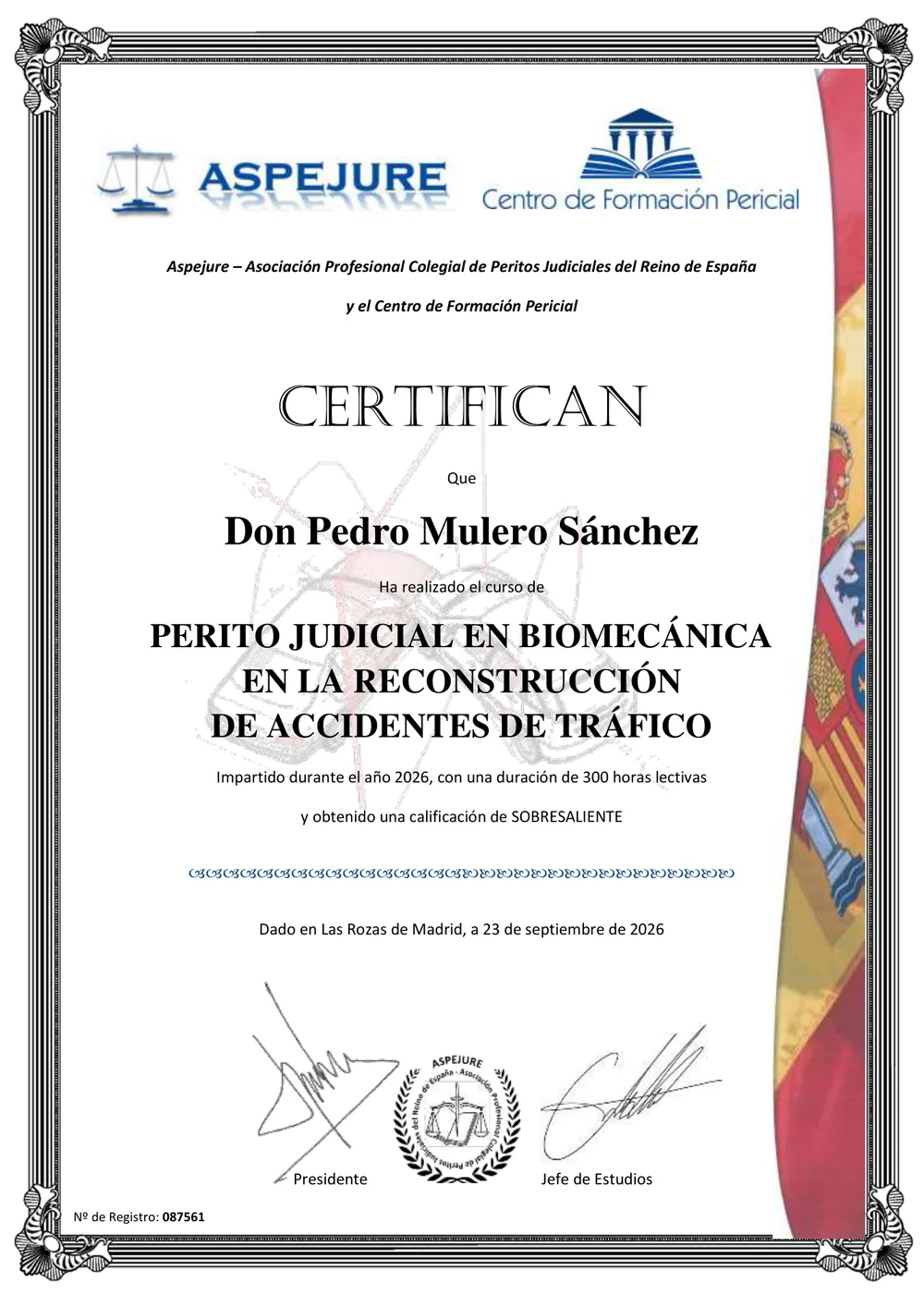 Court Expert in Biomechanics in Traffic Accident Reconstruction - 300 hours - Distinction
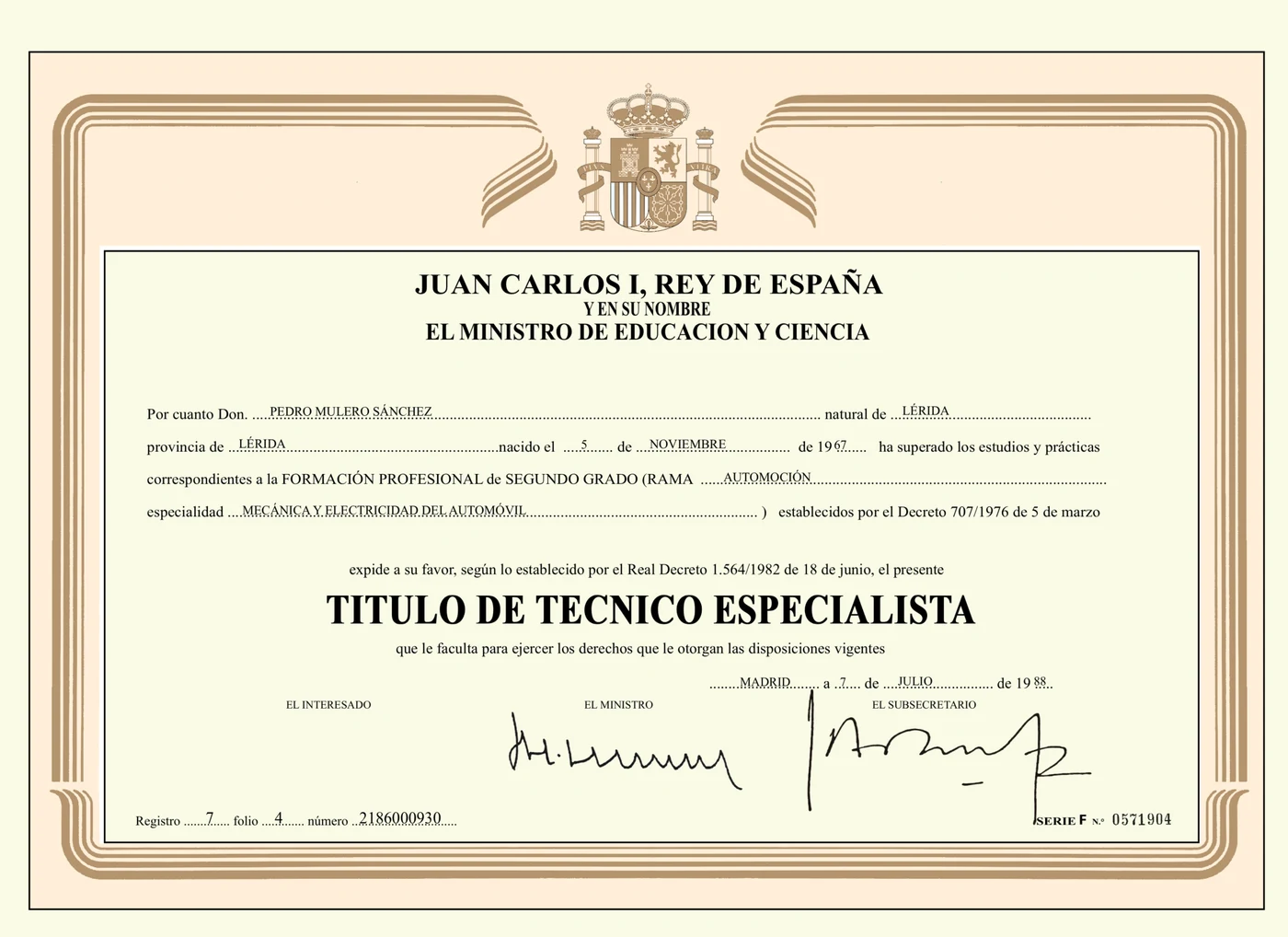 Specialist Technician in Motor Vehicles - Vehicle Mechanics and Electrics
 Court expert witness · ASPEJURE member no. 03667
Speciality listed on the rolls of court experts throughout Spain.
Frequently asked questions
What is the intensity criterion?
It is one of the four criteria in art. 135 for compensating minor neck trauma: that the intensity of the accident was capable of producing the injury. The other three are exclusion, chronology and topography. The biomechanical report supplies the physical side of the intensity criterion: the energy and acceleration of the impact.
Do you diagnose the injury?
No. Diagnosis, progress and after-effects are assessed by the doctor. I calculate the impact energy and the occupants' acceleration, which is what the intensity criterion needs measured. The two reports complement each other.
Is it any use against the insurer's report?
That is what it is for. Many insurer reports apply a fixed speed threshold without engaging with the actual case. A report that calculates from the real damage to both vehicles and from the mechanism the doctor describes usually dismantles that generalisation.
Free first consultation and a fixed written quote. I reply within 24-48 working hours.